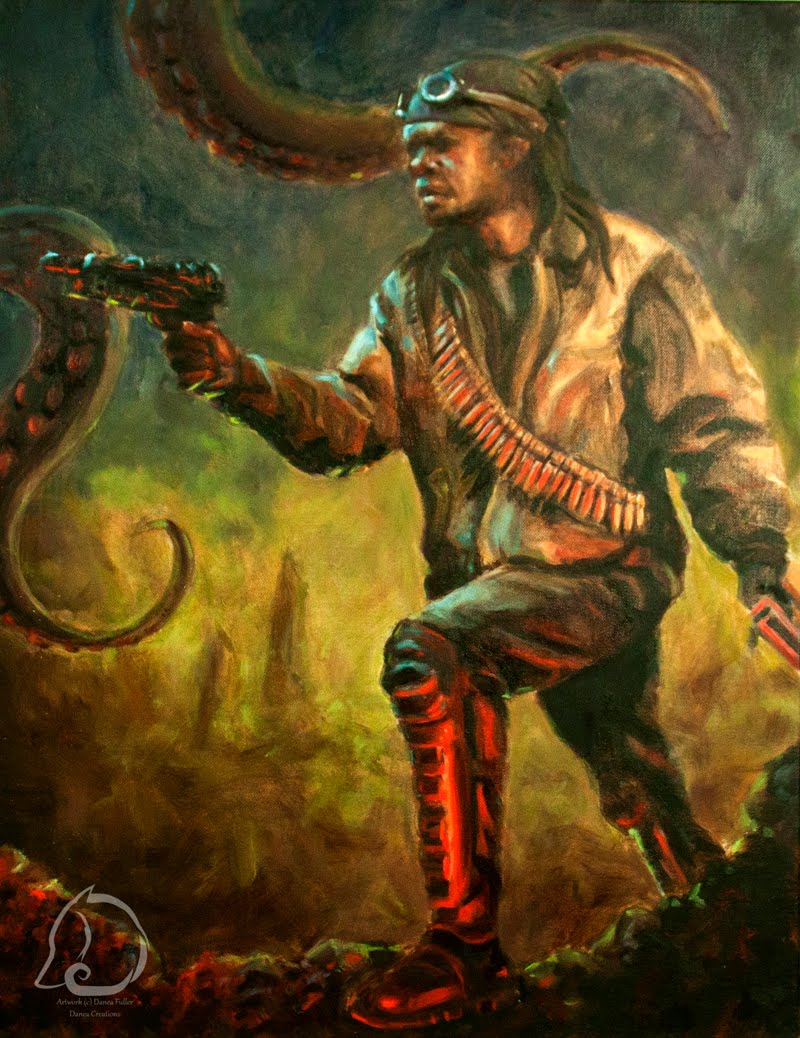
Starting this week, I plan on posting a new piece of art here at least once a week till finals start and then after graduation.
The piece for today is a self portrait I did for Computer Illustration 1 over the summer. We had to create a surreal self portrait of ourselves. It didn't have to look like us as long as someone could recognize it as us. I created an arctic wolf okapi that I dressed up in clothing that I normally were every day.
This was one of my first real digital paintings I've really done successfully and I learned a ton while doing it. The main things were that even in digital painting, underpaintings or quick speed painting studies help a lot. Also shortcuts are your friend.
Hope you all enjoy. Here is also my process of the painting.
~Danea
Thursday, January 10, 2013
Saturday, June 23, 2012
Bears, Paintings, Progress
Here are some projects from spring semester of this year, as well as some studies and sketches of the projects.
This project of the dancing bears was for a short story project in my illustrating literature class. This is an illustration of as scene from Brilliant Sillence by Spencer Holst:
"Two Alaskan Kodiak bears joined a small circus where the pair appeared in a nightly parade pulling a covered wagon. The two were taught to somersault, to spin, to stand on their heads, and to dance on their hind legs, paw in paw, stepping in unison. Under a spotlight the dancing bears, a male and a female, soon became favorites of the crowd. The circus went south on a west coast tour through Canada to California and on down into Mexico, through Panama into South America, down the Andes the length of Chile to the southernmost isles of Tierra del Fuego.
There a jaguar jumped the juggler, and afterwards, mortally mauled the animal trainer, and the shocked showpeople disbanded in dismay and horror. In the confusion the bears went on their own way. Without a master, they wandered off by themselves into the wilderness on those densely wooded, wildly windy subantarctic islands. Utterly away from people, on an out-of-the way uninhabited island, and in a climate they found ideal, the bears mated, thrived, multiplied, and after a number of generations populated the entire island. Indeed, after some years, descendants of the two moved out onto half a dozen adjacent islands, and seventy years later, when scientists finally found and enthusiastically studied the bears, it was discovered that all of them, to a bear, were performing splendid circus tricks.
On nights when the sky is bright and the moon is fully, they gather to dance. They gather the cubs and juveniles in a circle around them. They gather together out of the wind at the center of a sparkling, circular crater left by a meteorite, which had fallen in a bed of chalk. Its glassy walls are chalk white, its flat floor is covered with white gravel, and it is well-drained, and dry. No vegetation grows within. When the moon rises above it, the light reflecting off the walls fills the crater with a pool of moonlight, so that it is twice as bright on the crater floor as anywhere else in that vicinity. Scientists speculate that originally the full moon had reminded the two bears of the circus spotlight, and for that reason, they danced. Yet, it might be asked, what music do the descendants dance to?
Paw in paw, stepping in unison, what music can they possibly hear inside their heads as they dance under the full moon and the Aurora Australis, as they dance in brilliant silence?"
~Spencer Holst - Brilliant Silence
Acrylic black and white painting of David.
Master Copy of a Rembrandt painting.
Next three paintings are some more paintings from Life Painting 1.
~Danea
This project of the dancing bears was for a short story project in my illustrating literature class. This is an illustration of as scene from Brilliant Sillence by Spencer Holst:
"Two Alaskan Kodiak bears joined a small circus where the pair appeared in a nightly parade pulling a covered wagon. The two were taught to somersault, to spin, to stand on their heads, and to dance on their hind legs, paw in paw, stepping in unison. Under a spotlight the dancing bears, a male and a female, soon became favorites of the crowd. The circus went south on a west coast tour through Canada to California and on down into Mexico, through Panama into South America, down the Andes the length of Chile to the southernmost isles of Tierra del Fuego.
There a jaguar jumped the juggler, and afterwards, mortally mauled the animal trainer, and the shocked showpeople disbanded in dismay and horror. In the confusion the bears went on their own way. Without a master, they wandered off by themselves into the wilderness on those densely wooded, wildly windy subantarctic islands. Utterly away from people, on an out-of-the way uninhabited island, and in a climate they found ideal, the bears mated, thrived, multiplied, and after a number of generations populated the entire island. Indeed, after some years, descendants of the two moved out onto half a dozen adjacent islands, and seventy years later, when scientists finally found and enthusiastically studied the bears, it was discovered that all of them, to a bear, were performing splendid circus tricks.
On nights when the sky is bright and the moon is fully, they gather to dance. They gather the cubs and juveniles in a circle around them. They gather together out of the wind at the center of a sparkling, circular crater left by a meteorite, which had fallen in a bed of chalk. Its glassy walls are chalk white, its flat floor is covered with white gravel, and it is well-drained, and dry. No vegetation grows within. When the moon rises above it, the light reflecting off the walls fills the crater with a pool of moonlight, so that it is twice as bright on the crater floor as anywhere else in that vicinity. Scientists speculate that originally the full moon had reminded the two bears of the circus spotlight, and for that reason, they danced. Yet, it might be asked, what music do the descendants dance to?
Paw in paw, stepping in unison, what music can they possibly hear inside their heads as they dance under the full moon and the Aurora Australis, as they dance in brilliant silence?"
~Spencer Holst - Brilliant Silence
Acrylic black and white painting of David.
Master Copy of a Rembrandt painting.
Next three paintings are some more paintings from Life Painting 1.
~Danea
Monday, June 18, 2012
The most giant of updates
Hello all,
It's been awhile since I've updated here on the blog, and I do apologize for that. For the next week or two I plan on posting every to every other day in order to get this blog up to date and up to speed without posting everything all in one giant post. That would be way to long to go through.
For this post, here is the pieces I promised to update with so long ago from fall semester. The prelims have been sitting here for so long and now here are the finished pieces. Enjoy.
Best piece of the fall semester that came out of Conceptual Illustration. This is suppose to illustrate an article on genetic dating.
Final in Landscape Painting.
Final in Conceptual Illustration. It's suppose to illustrate a headline that said "Enjoy baking cookies with your children".
Landscape of a Lake in Lakewood, Colorado.
Watercolor painting in Life Drawing 4.
A sculpture for conceptual illustration that illustrates overpopulation, specificly to the Walia Ibex.
Landscape of the Golden River.
Conceptual Illustration for an article on the over population of the American wild boar.
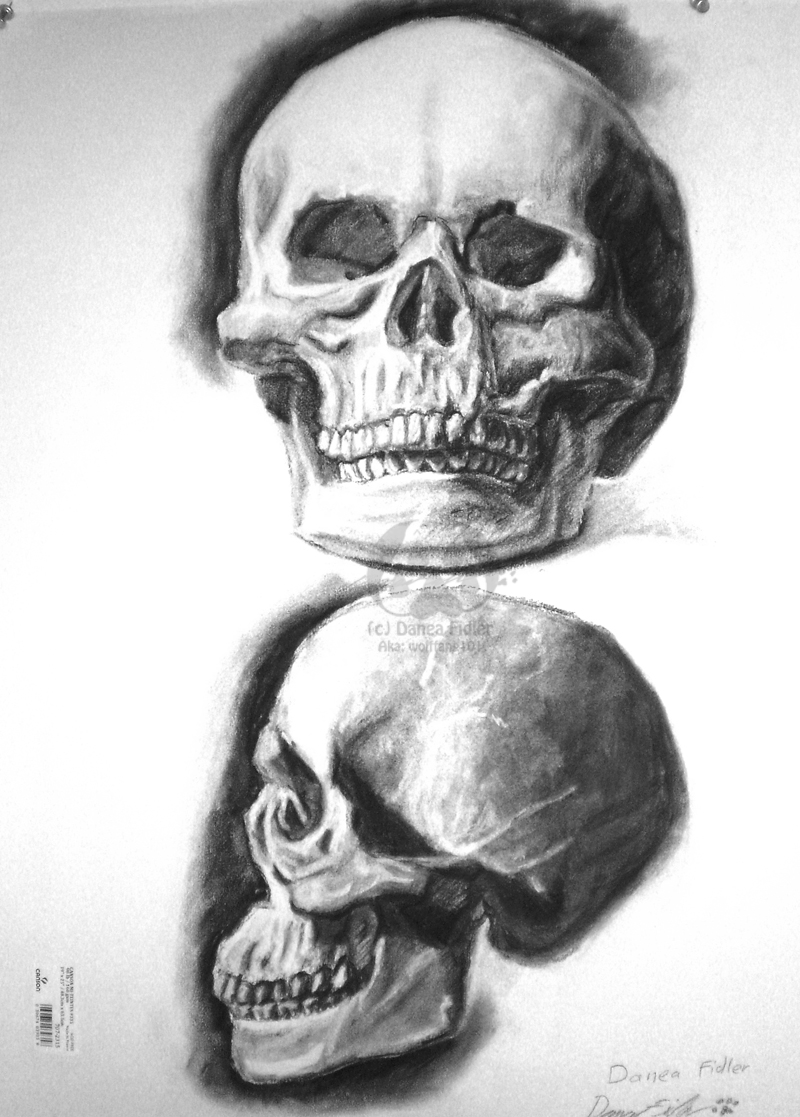
Skull studies in life drawing 4.
Hope you enjoy. The next post will be from the Spring semester. Either prelims, finals, or both :).
For this post, here is the pieces I promised to update with so long ago from fall semester. The prelims have been sitting here for so long and now here are the finished pieces. Enjoy.
Best piece of the fall semester that came out of Conceptual Illustration. This is suppose to illustrate an article on genetic dating.
Final in Landscape Painting.
Final in Conceptual Illustration. It's suppose to illustrate a headline that said "Enjoy baking cookies with your children".
Landscape of a Lake in Lakewood, Colorado.
Watercolor painting in Life Drawing 4.
A sculpture for conceptual illustration that illustrates overpopulation, specificly to the Walia Ibex.
Landscape of the Golden River.
Conceptual Illustration for an article on the over population of the American wild boar.
Skull studies in life drawing 4.
Hope you enjoy. The next post will be from the Spring semester. Either prelims, finals, or both :).
Wednesday, December 28, 2011
Prelims to Fall Semester
Ok... well.. I've been so busy lately I wasn't able to post prelims here like I wanted to, so I thought I would at least show some preliminary stuff now before I post some final products. Also to bring an end to the year too :). Here is what I've been up to for the past 3 or 4 months :). Enjoy. I'll post the final products of these later on.
More zoo studies, final products, zbrush modeling stuff, life drawing pieces, and digital pieces to come!
Thursday, September 1, 2011
Shifting Moon
Well, I'm finally done! My piece for the Werewolf Calendar Contest is finally done! I do have to admit that this is probably one of my best pieces background and lighting wise. I had a lot of fun with this.
-------
It is commonly believed that the full moon forces werewolves shift from their human forms. This, however, isn’t completely true. Werewolves do shift during the full moon most of the time, but only at will and because it’s more convenient for them. Under the cover of night and the full moon lighting up the sky to see by, werewolves have the chance to shift without being seen by other humans. The full moon also provides enough light for them to hunt, have family gatherings, or do rituals. This time of the month is especially convenient for the werewolves who live mostly as humans and are around some kind of civilization. It provides them with a time where they can shift at least once a month and be safe from human eyes in the darkness of night.
Some werewolves live a semi-normal human life, some a hybrid life, and others a life in the wild as wolves. No matter what though, shifting is part of a werewolf’s life. It can be from becoming a wolf during the full moon for a family gathering once a month to changing back to human once in awhile to stay safe when other people are around. Either way, every werewolf shifts and every time they do it’s always an incredibly painful experience.
Shifting requires a ton of energy and pain tolerance. To shift is to change the anatomy of one’s self at will. All at once, one’s bone structure has to reform and muscles must be grown and morphed. Pain tolerance is built up over time from early teen years to deal with this. New werewolves who are bitten always have a hard time shifting and are not always fully able to stand it. After shifting a werewolf’s energy is at its lowest and it is very vulnerable to others at this time. If one doesn’t shift over a long period of time (usually 4 to 5 months or more), when they eventually do it becomes almost too painful to do it ever again. Pain tolerance from shifting a lot or even once a month for the full moon is something that must be done to avoid this and to keep up their strength so they are not so vulnerable afterwards.
------------
This werewolf has just shifted and has just fallen on almost all fours due to the pain. A young werewolf like this one hasn't built up a lot of pain tolerance quite yet. He is strong though and is breathing through it to recover. A lone werewolf like this one must be careful shifting because there might be others around. This is why the safest thing to do is to shift under the cover of a forest. Hopefully the trees hide him from the eyes of others.
I put a lot of thought and time into this and had a lot of fun doing something like this for myself for once. I've had this concept in my head for awhile now and I've decided to summit it to the Werewolf Calendar's contest. I've been working on this off and on since the end of July and just finished it about a week ago. The concept came to me when I was studying anatomy and was looking some werewolf pieces. I couldn't help but think how they would change their anatomy and such shifting, so yeah.
This is the smaller and watermarked version. The original scan is being sent to them through e-mail. Wish me luck :).
Also I need someone's opinion. I forgot to add the cold breath coming from his mouth. Should I still add it or should I leave it be?
And as always, critiques are most welcome and appreciated!
Thanks :),
Danea
Wednesday, August 10, 2011
Final Projects
Well here is my Lopari final design that I did for my final project in my animal anatomy class.
The Lopari is a combination of a leopard, a giraffe, and a tapir. The lopari is a carnivore and is a bit bigger than a normal leopard. It's a odd-toed creature like the tapir and it's hoof-like claws retract in it's front paws. With its pattern, I combined a leopard and giraffe spots as well as the stripes of a baby tapir.
I do have a long story about it, but for the most part it's explained in the description in the design. It is endangered, because the Wiric had moved into it's habitat and has hunted them and their food supply to where it's hard for them to survive.
This is the illustration I did to go with the design. I decided to make a character along with the species. his Lopari is a worn down, scruffy, old one with scares showing his fights and battles with the Wiric creatures. He is also very strong though since rarely do these creatures survive to be this old these days.
He is chasing an elephant shrew like animal to show that even though the Lopari needs a lot of food to survive, due to the Wiric, it usually can only find small creatures to hunt. Because of this, Loparis are constantly hunting around for new food.
The environment that the Lopari live in is shown here too. It's sort-of like an Australian/ African savanna, desert like forest. The trees here have large trunks to save water in them since it's a very dry and hot climate with very little rain. When the wet season comes these trees absorb as much water as they can and it usually lasts them through the dry season.
Hope you all like :). Critique is much appreciated.
Monday, August 1, 2011
Wolfy studies
Before I post my final projects I thought I would post some value studies of the project I'm working on now for the Werewolf Calendar contest. If I could get some feedback on these I would really appreciate it :). The more help the better.
Subscribe to:
Posts (Atom)